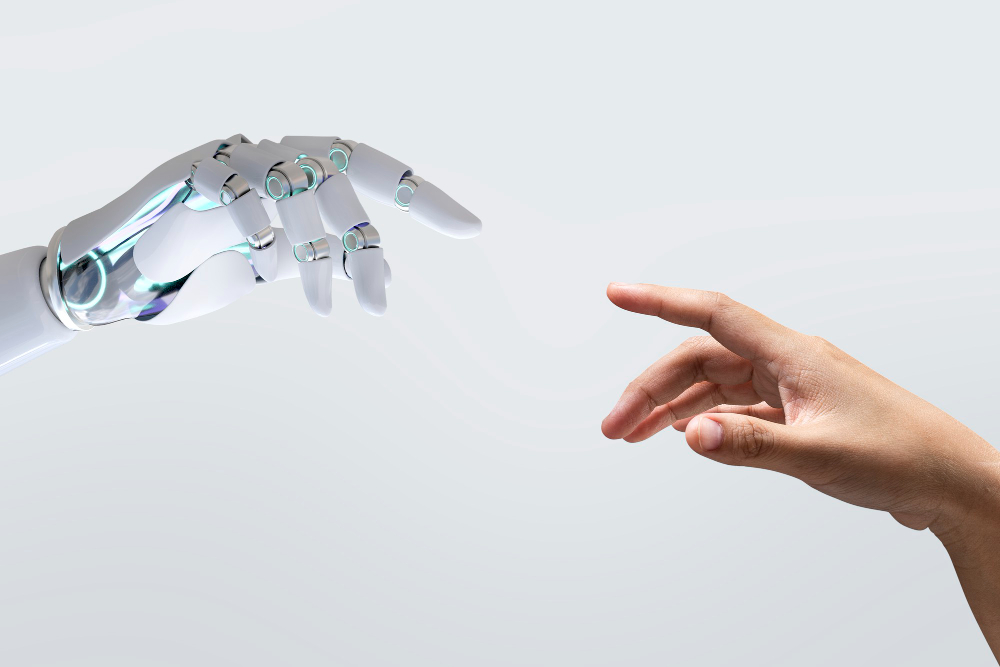

In this comprehensive article, we will look at the definition of artificial intelligence. We will also look at the different categories of AI systems. We'll look at its benefits. Finally, we'll look at real-life case studies of companies that have taken advantage of this technology.
So if you're interested, let's get started!
Full definition of artificial intelligence (AI)
Artificial intelligence refers to the technology that aims to develop systems and machines capable of performing tasks that generally require human intelligence. AI involves the design, development and implementation of algorithms, models and systems capable of processing, understanding, learning and adapting to complex data. All this enables intelligent decisions to be made and action to be taken to achieve specific objectives.
AI encompasses a wide range of techniques and approaches, including machine learning, natural language processing, robotics and more. These methods enable AI systems to analyse large volumes of data, recognise patterns, extract meaningful information and continually improve performance through learning and experience.
Machine learning, a key subset of AI, involves building algorithms that allow computers to learn from data and make predictions or decisions without being explicitly programmed. Using statistical and pattern recognition techniques, these machine learning algorithms can identify patterns, generate models and make predictions or recommendations based on new data.
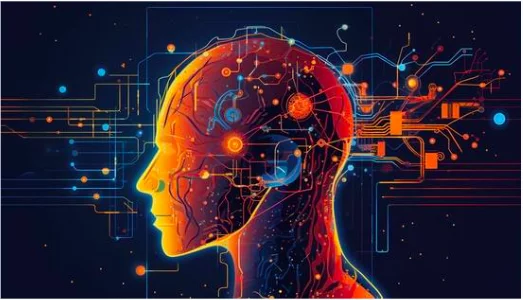
Different categories of AI systems
AI systems can be divided into two main categories:
- Narrow AI refers to systems designed to perform specific tasks or solve particular problems within a limited domain. These systems excel at specialised tasks, such as playing chess or diagnosing diseases.
- General AI aims to develop machines capable of performing any intellectual task that a human can. General AI is said to have a wide range of cognitive capabilities, including reasoning, learning and understanding in various fields.
Case studies
Fujitsu example The research results provide several references to Fujitsu, a multinational IT equipment and services company. According to a research project led by Jenny Areback and Hanna Rönnberg, Fujitsu conducted a case study in 2017 that illustrates the potential positive outcomes of implementing AI in the healthcare sector. The case study identified a problem in Spain in 2014. The problem was that a large number of patients were waiting a long time to receive medical care. Fujitsu implemented an AI system that reduced waiting times and improved patient care.
We can also mention Fujitsu's work in augmenting human expertise with AI to detect brain aneurysms and save lives. Overall, the research findings suggest that Fujitsu is involved in the development and implementation of AI solutions in various sectors, including healthcare and public health.
Here is another case study that you can read by clicking on the link : https://www.oecd-ilibrary.org/sites/01a4ae9d-en/index.html?itemId=/content/component/01a4ae9d-en#section-d1e25237
Benefits of using AI
Greater efficiency and productivity
Companies that harness this intelligence can automate repetitive tasks. They can also streamline processes and improve operational efficiency. AI systems can process large volumes of data. They can also perform complex calculations at a much faster rate than humans. This translates into increased productivity and reduced human error.
Improving the customer experience
AI technologies, such as chatbots and virtual assistants, can provide immediate, personalised customer support. All this while improving the overall customer experience. AI-powered recommendation systems can offer tailored product suggestions. These advances lead to greater customer satisfaction and increased sales.
Cost reduction
By automating tasks, AI can help businesses reduce labour costs and optimise resource allocation. AI-driven predictive maintenance can prevent costly equipment failures and minimise downtime. In addition, AI-powered inventory management systems can optimise stock levels, reducing storage and inventory costs.
Competitive advantage
The adoption of AI can offer a significant competitive advantage in today's digital landscape. Companies that use AI can develop innovative products and services, create personalised marketing campaigns and gain insights into market trends and customer preferences. This enables them to stay one step ahead of the competition.
Improving risk management
AI can help identify and mitigate potential risks by analysing large data sets and detecting anomalies or patterns that may indicate fraud, security breaches or compliance violations. This helps businesses deal with risks proactively. So they can protect their assets and reputation.
Imagine you're a business strategy consultant and you don't have any web design skills. Don't panic! You don't need to hire a web agency to develop your website. You can use AI to create content for your blog or social media.
If you'd like to find out more about AI and why you should implement it in your SME, be sure to read our previous article: AI: a service to help your SME grow.
Examples of companies that have improved their productivity thanks to AI
Siemens
Siemens has implemented AI in its manufacturing processes to improve efficiency and product quality. Thanks to this technology, the company has been able to reduce the development time of certain products by 30 %. It has also increased the manufacturing quality of electronic components by 20 %.
Google has used AI to improve the efficiency of its data centres. Using machine learning algorithms, Google has managed to reduce its cooling energy consumption by 40 %. This has significantly improved the energy efficiency of its data centres. This improvement has reduced costs and environmental impact.
DHL
This logistics and transport company has implemented AI to optimise its delivery operations. Using machine learning algorithms, DHL has been able to predict demand and delivery trends, optimise delivery routes and reduce driver waiting times. As a result, the company's productivity increased by 8 %.
Deutsche Bank
This bank used AI to automate certain administrative and data processing tasks. Thanks to this automation, the bank has reduced the time it takes to process loan documents by 70 %. As a result, it was able to process a much higher volume of loan applications. All the while maintaining a high level of accuracy.
General Electric
General Electric has used AI in its predictive maintenance operations to improve the availability of its industrial equipment. By analysing sensor data in real time, the technology has enabled GE to predict equipment failures with greater accuracy. This has improved the efficiency of maintenance operations and reduced unplanned downtime. This approach has saved GE up to 12 % in annual maintenance costs.
Examples of companies that have improved their revenues thanks to AI

Some companies have succeeded in increasing their turnover through the strategic use of artificial intelligence (AI). Here are just a few examples:
Amazon
Amazon is a leading example of a company that has used AI to boost revenue. Reports suggest that Amazon's AI-based product recommendation algorithm accounts for up to 35 % of the company's sales. In 2020, Amazon's revenue reached nearly $386 billion. This number testifies to the positive impact of artificial intelligence on its business model.
Netflix
AI has played a key role in Netflix's growth by enabling personalised content recommendations. Data suggests that more than 80 % of viewing hours on Netflix come from AI-based recommendations. By 2020, Netflix's revenue will be close to $25 billion.
Alibaba
This Chinese e-commerce giant, has used AI to improve sales and increase revenue. According to published data, Alibaba recorded sales of more than $109 billion on Singles' Day 2020, a major promotional event. The use of AI in product recommendations and sales optimisation contributed to this performance.
Salesforce
The company, which specialises in customer relationship management software, is using AI to improve its customers' sales performance. In 2020, Salesforce announced that companies using its AI system, called Einstein, saw an average increase in revenue of 26 % thanks to improved sales efficiency and personalised customer experience.
These two types of examples show how the use of AI can help to stimulate business growth and increase turnover. The specific data may vary depending on the sector, the size of the business and the implementation of AI. It is important to note that the impact of AI on revenue can be influenced by other factors such as overall business strategy, market competition and economic conditions.
Conclusion
In conclusion, as businesses strive to navigate a data-driven world, it is becoming increasingly imperative to embrace AI. By harnessing the power of AI, businesses can unlock increased efficiency, improved customer experience, cost reductions, competitive advantages and effective risk management.
Real-world case studies of successful AI adoption show tangible benefits in terms of improved productivity and revenue growth. As AI continues to evolve, companies that strategically integrate AI into their operations are positioning themselves for sustained growth and competitive advantage in an ever-changing marketplace.
Need someone to implement your AI solution? Contact iterates