A New Form of Matter, A New Type of Computing
Quantum computing often sounds like a concept straight out of a science fiction film. However, with Microsoft's recent announcement of the Majorana 1 chip, a real revolution could be closer than we think. Satya Nadella, Chairman and CEO of Microsoft, even goes so far as to describe this breakthrough as the creation of a whole new state of matter, beyond the three classic forms we know: solid, liquid and gas.
«Most of us were taught that there were three states of matter: solid, liquid and gas. Today, that has changed.
...After nearly 20 years of research, we have created an entirely new state of matter, made possible by a new class of materials, topoconductors, which are enabling a fundamental leap forward in computing.»
- Satya Nadella, Chairman and CEO of Microsoft
What does this mean in concrete terms? It means that we are approaching a generation of quantum computers capable of solving problems that are currently inaccessible to even the most powerful supercomputers. This advance could lead to major breakthroughs in fields such as healthcare, pharmaceutical research, artificial intelligence, logistics and many others.
Why quantum computing is a revolution
Before exploring the Majorana 1 chip in detail, let's take a look at why quantum computing is a game-changer:
- Classic computers Bits: use bits (0 or 1) to store information.
- Quantum computers These use qubits, which can be 0 and 1 simultaneously, a phenomenon known as superposition. Qubits can also be intricate, which means that they can influence each other instantaneously.
Thanks to these properties, quantum computers have the potential to perform certain calculations exponentially faster than any conventional computer. The problem? Qubits are extremely fragile and the slightest disturbance can generate errors.
This fragility is one of the main obstacles to the construction of truly functional quantum computers on a large scale. This is precisely where Microsoft's approach, based on topoconductors and Majorana particles, could offer a breakthrough.
Majorana 1 in brief
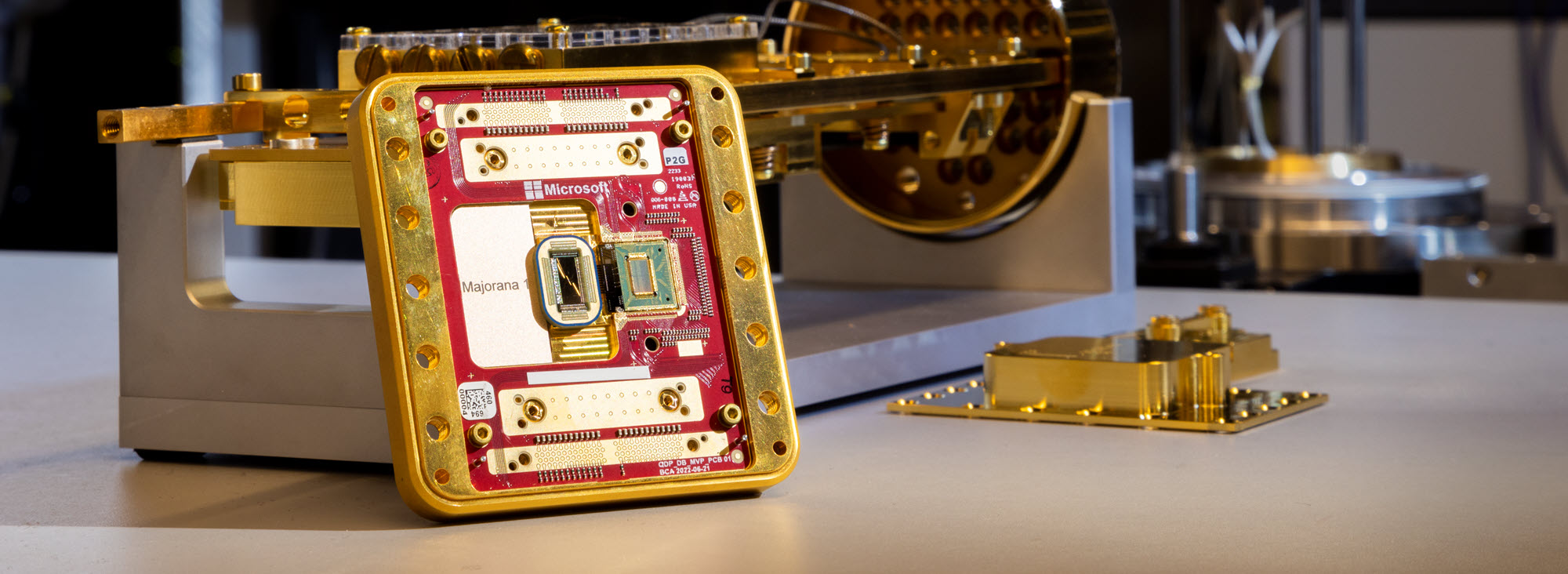
The chip Majorana 1 from Microsoft is a quantum processor (also known as a Quantum Processing Unit or QPU) built on a topological core. It introduces :
- Topoconductors a new class of materials designed to house Majorana's particles.
- Majorana's particles exotic quantum states that naturally protect the qubits from external interference.
Built-in stability
Unlike classical quantum systems, which require massive error correction, Majorana qubits aim to reduce errors at the hardware level. Imagine a house designed to be naturally watertight rather than needing to pump water out all the time.
“The qubits created with topoconductors are faster, more reliable and smaller. They measure 1/100th of a millimetre, which allows us to envisage a processor with a million qubits.” - Satya Nadella
In the quantum field, going from a few qubits to a million is an advance comparable to going from a single puddle of water to an entire ocean. If Microsoft succeeds, quantum computing could finally become a technology with real impact.
According to CNBC, Microsoft is aiming for a gigantic leap forward in scalability, with a roadmap that calls for the chip to be extended to a million qubits. This scale will transform the world of quantum computing.
Why topological qubits are essential
Today, most quantum computers work with a few dozen or a few hundred qubits. This is impressive, but not enough to solve complex problems such as modelling molecules for medical research or optimising supply chains.
Obstacles to expansion
- High error rates Traditional qubits are very sensitive to disturbances.
- Complex architecture The more qubits you add, the harder it is to stabilise the system.
Microsoft's solution
By incorporating error protection directly into the design of qubits, topological qubits could reduce the need for massive error correction, making it easier to build a million-qubit quantum processor.
Comparison: Microsoft vs Google
| Criteria | Google (superconducting qubits) | Microsoft (topological qubits) |
|---|---|---|
| Progressive improvements | Constant refinement of superconducting circuits | New architecture using innovative materials |
| Error correction | Massive need for correction algorithms | Reducing hardware errors |
| Materials | Traditional superconductors | Top conductors (indium-arsenide and aluminium) |
| Long-term vision | Progress in stages | Objective: avoid certain current limitations |
A global impact
If Microsoft succeeds in deploying Majorana 1 on a large scale, it could transform several industries:
- Health Molecular simulations to speed up the search for new drugs.
- AI and Machine Learning Improving pattern recognition and combinatorial optimisation.
- Cryptography : New forms of security resistant to quantum attacks.
- Logistics Optimisation of supply chains and transport.
- Climate modelling : More accurate weather forecasts.
The future of quantum computing is taking shape, and Microsoft's developments could well be a decisive catalyst.