
Proof of concept - Article by Amélie Viardot
You're thinking of developing a new product or service and you've heard about proof of concept (POC). But you're not sure what it is or how it could benefit your business. Look no further! In this article, we'll provide you with a complete guide to POC, including its definition. We'll also cover its advantages, disadvantages and the process of developing a successful POC. We'll also look at the differences between POCs, prototypes and minimum viable products (MVPs). Finally, we will give examples of successful POCs in various sectors.
Let's go !
Proof of concept: definition
There are several stages in the process of developing a product or service. Among these stages, proof of concept (POC) is a crucial one that tests the feasibility of an idea or concept before investing significant resources in developing a product or service.
Proof of concept involves creating a small-scale project to validate or invalidate a hypothesis, check the viability of the idea, identify potential problems and gather feedback from stakeholders or users. This reduces the risks and costs associated with creating a product or service that may not be as successful as expected.
There are two types of POC:
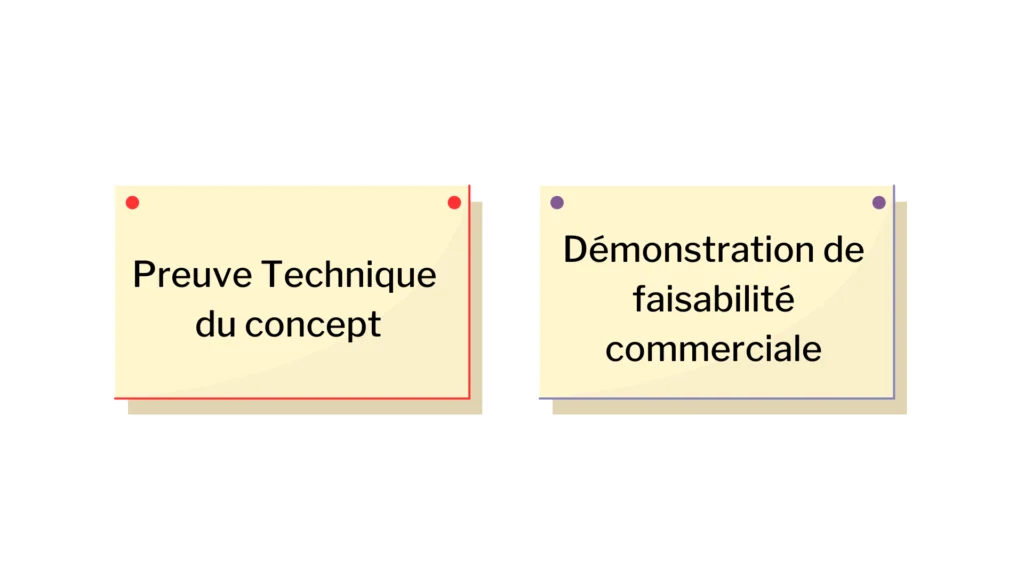
- Technical proof of concept This type of POC aims to test the technical feasibility of an idea or concept. It involves building a small-scale prototype or model to demonstrate the technical capabilities of a product or service. Technical POCs are generally used in the early stages of product development. This allows us to verify that a particular technology or methodology can be used to achieve the desired results.
Testing the interconnection between your web application and an external application is a good example of a technical POC. For this POC, you will try to exchange one or a few of the many values you wish to exchange with the external services with which you wish to connect. If this works, you are confirming that the two pieces of software can be interconnected. You're ready to move on to the next stage.
- Demonstration of commercial feasibility : This type of POC aims to test the commercial feasibility of an idea or concept. Unlike a technical POC, it involves the creation of a small-scale project to check whether there is a market for the product or service and to validate the business model. Business POCs are generally used to gather feedback from potential customers and to test the viability of a product or service in the marketplace. They are often also used to generate leads.
It is important to note that the proof of concept will take a different form depending on your objective or idea:
- a landing page, i.e. a one-page website
- a simple form, using Typeform or Google Form
- a leaflet presenting your idea
- selling a service that you have not yet launched by telephone, in the street or at a trade fair
- a visual created using PowerPoint or a mock-up creation solution such as MarvelApp
- an advert published on social media
- …
A POC is often an «empty shell». You just want to make sure you're solving customers' problems. Once your concept has been validated, you'll need to create a minimum viable product - or MVP - to make your idea a reality.
The objective of Proof of Concept
Its main objective is to get as much feedback as possible from your market or technical field before you start developing your project. It's the ideal solution for people who want to quit their job to set up a new business. It's risk-free and will let you know if your idea has real potential.
The main objective of a POC is to get a “GO” or a “NO GO” on your idea based on market reactions or technical results... before you even start investing your time and money in developing the idea. Building a proof of concept will save you a ton of money!
Imagine you want to create a web platform that lists senior flatmates. Nothing could be simpler: you create a simple web page on which you present your idea, and you promote it via paid advertising. Result: two possibilities:
- You generate qualified leads: move on to the next stage, creating an MVP as the first version of your solution.
- You get few or no leads: either the idea does not yet have a market, or the perceived value of your idea is not yet clear enough. In this case, you need to test a new POC or a new way of presenting your idea.
Examples of successful proofs of concept
There are many examples of successful POCs in various sectors, including B2B and B2C services and software development. Here are just a few examples
- Dropbox Dropbox: It's one of the best-known POCs. Dropbox's proof of concept was a video demonstrating how the product would work. This video allowed the company to gauge interest in the product before creating the software itself. There was a lot of positive feedback from the community. Watch the video here.
- SwipeWell SwipeWell is a mobile application designed to manage credit card debt. By creating a simple, functional version of the application and testing it with a small group of users, SwipeWell was able to identify areas for improvement. In this way, the founders gathered feedback from users before launching a real application. This process took months of hard work.
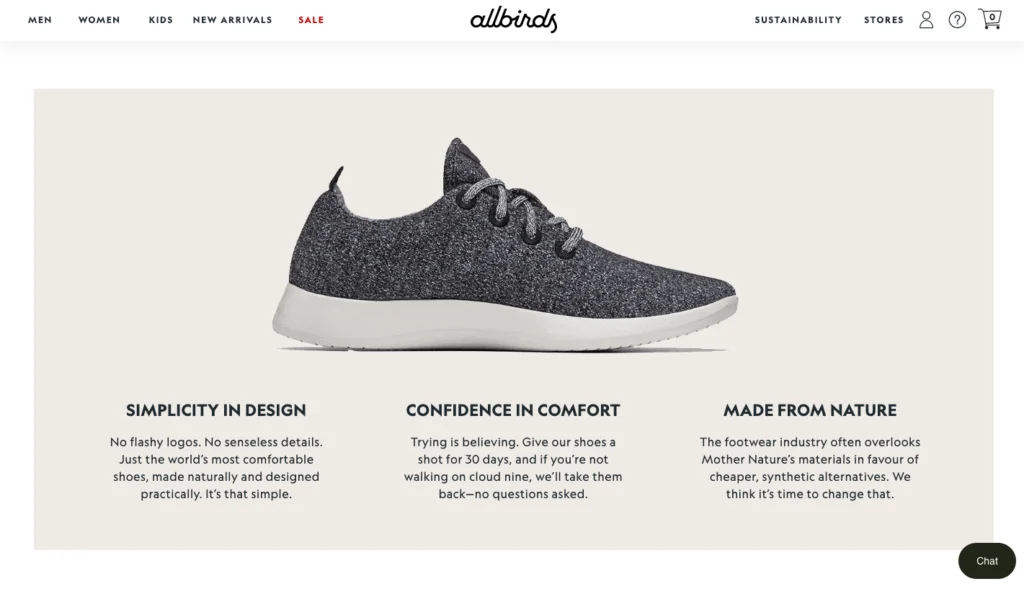
- Allbirds The co-founders came up with the idea of eco-friendly shoes. They tested them on the market to gather feedback. The feedback was very positive. It helped them find the funding they needed to produce the shoes on a larger scale. The success of the POC enabled Allbirds to go ahead with production. Today, Allbirds is a thriving business that prioritises sustainability in all aspects of its operations. For more information: Our history
- Buffer Buffer, a social media management platform. This is an excellent example of a company that successfully used POC to validate its business concept. Buffer used a proof of concept by creating a landing page that explained its product, even though it didn't exist at the time. The landing page included a registration form where potential customers could express their interest in the product. A perfect lead generation strategy. Leads that were easy to activate when the company launched the first version of the product.
- Etsy By creating a small-scale website and gathering feedback from its target audience, Etsy was able to demonstrate the viability of the concept and generate interest from buyers and sellers. This success enabled it to obtain funding to continue its development and expand its offering. The result was the well-established online marketplace we know today.
POC vs Prototype vs MVP
Before going into the details of the POC, let's clarify the difference between a prototype, an MVP and a POC.
A prototype is a physical or working model of the proposed product or service. Its objective is provide a visual representation of what the product could look like and how it could work. You already have to invest in the development of this product to create a prototype. In general, the cost of development is not negligible. What's more, you'll need to devote time to developing the prototype.
Bear in mind that if you haven't created a POC before, a simple advert with a 3D model of your product for example, you're not yet sure that your market is interested in your product.
A Minimum Viable Product (MVP) is the first version of your product that includes basic and essential features. It is designed to test the viability of your business idea. Often, the MVP will enable you to obtain initial funding from your target audience.
The MVP is not a complete product. Rather, it is a version of your product with the minimum number of features needed to deliver value to your target audience. The MVP is designed to continue to provide feedback to users and help you make informed decisions about the development process: which new features should be developed? To find out more about the MVP, read this article: MVP meaning: a full explanation of Minimum Viable Product.
Proof of concept is used to vCheck whether an idea or concept is feasible and has the potential to work as intended. A POC must demonstrate that the idea or concept for a product is viable before you even start developing it.
Benefits of POC
- Check feasibility By carrying out a POC, you can demonstrate that your idea has the potential to work as intended.
- Reducing risks POCs enable potential problems to be identified at an early stage in the development process, which helps to reduce risks.
- Profitability By testing a concept on a small scale, you can determine whether it has the potential to be developed further.
- Time saving By testing a concept using a POC, you can quickly identify flaws and improve the product or service.
Disadvantages of POC
- Misleading results POCs are generally carried out in a controlled environment, which may not faithfully represent real-world scenarios.
- Limited range POCs are generally small-scale projects that do not represent the full scope of the final product or service.
- Lost opportunities Don't validate an interesting idea because the POC's value proposition wasn't clear. Another possibility is not addressing your target correctly (wrong channel or message). This is why you can spend time testing several approaches / POCs before deciding to stop your project.
The concept validation process
Now that we've discussed the pros and cons of POC, let's dive into the POC process itself. The POC process involves the following steps:
- Define the concept/idea The first step in developing a POC is to clearly define the concept or idea you want to test. This involves identifying the target audience, the market demand and the business plan.
- Identify feasibility Once you have identified the concept or idea, the next step is to check its feasibility. This involves conducting research, analysing user reactions and gathering feedback from members of your team to determine whether the idea is feasible.
- Choose a support for your POC Proof of concept: your proof of concept can be a working prototype, but it doesn't have to be. As explained above, it can also be an empty shell that presents your idea. Find the best way to test your idea as quickly as possible. Your choice will also depend on how much time and money you are prepared to invest in validating your POC.
- Implementing the POC The POC must include a description of the product or service, its target audience and the benefits it offers. The POC should also contain details of how the product or service will work and how it will be developed in the future.
- Test the POC and gather feedback Once the POC has been created, the next step is to test it. This involves carrying out a limited trial to test the feasibility of the concept and determine whether it can be developed into a fully functional product or service. When testing the POC, it is essential to gather feedback from stakeholders, users and team members. This feedback can help you make informed decisions about the development process.
- Refining the concept Based on the feedback received, you may need to refine the concept or idea. This involves making improvements to the product or service based on feedback received during testing.
Conclusion
Proof of concept is a crucial stage in the product and service development process. They are used to check whether an idea or concept is feasible and has market potential.
By using POCs, companies can reduce risk, save time and money and improve communication with stakeholders. Although POCs have certain drawbacks, such as their limited scope and potentially misleading results, they can provide valuable information about the feasibility of a new product or service.
By following the POC process and gathering feedback from their targets, companies can refine their product development process and create successful products that meet the needs of their target audience, at low cost and with low energy consumption.
We hope this article has helped you to better understand what a proof of concept is. If so, we recommend that you also read our previous article on the meaning of minimum viable product (MVP). This will be your next step in developing your product or service.
Do you need our advice to develop your POC?
Proof of concept - Article by Amélie Viardot
You're thinking of developing a new product or service and you've heard about proof of concept (POC). But you're not sure what it is or how it could benefit your business. Look no further! In this article, we'll provide you with a complete guide to POC, including its definition. We'll also cover its advantages, disadvantages and the process of developing a successful POC. We'll also look at the differences between POCs, prototypes and minimum viable products (MVPs). Finally, we will give examples of successful POCs in various sectors.
Let's go !
Proof of concept: definition
There are several stages in the process of developing a product or service. Among these stages, proof of concept (POC) is a crucial one that tests the feasibility of an idea or concept before investing significant resources in developing a product or service.
Proof of concept involves creating a small-scale project to validate or invalidate a hypothesis, check the viability of the idea, identify potential problems and gather feedback from stakeholders or users. This reduces the risks and costs associated with creating a product or service that may not be as successful as expected.
There are two types of POC:
- Technical proof of concept This type of POC aims to test the technical feasibility of an idea or concept. It involves building a small-scale prototype or model to demonstrate the technical capabilities of a product or service. Technical POCs are generally used in the early stages of product development. This allows us to verify that a particular technology or methodology can be used to achieve the desired results.
Testing the interconnection between your web application and an external application is a good example of a technical POC. For this POC, you will try to exchange one or a few of the many values you wish to exchange with the external services with which you wish to connect. If this works, you are confirming that the two pieces of software can be interconnected. You're ready to move on to the next stage.
- Demonstration of commercial feasibility : This type of POC aims to test the commercial feasibility of an idea or concept. Unlike a technical POC, it involves the creation of a small-scale project to check whether there is a market for the product or service and to validate the business model. Business POCs are generally used to gather feedback from potential customers and to test the viability of a product or service in the marketplace. They are often also used to generate leads.
It is important to note that the proof of concept will take a different form depending on your objective or idea:
- a landing page, i.e. a one-page website
- a simple form, using Typeform or Google Form
- a leaflet presenting your idea
- selling a service that you have not yet launched by telephone, in the street or at a trade fair
- a visual created using PowerPoint or a mock-up creation solution such as MarvelApp
- an advert published on social media
- …
A POC is often an «empty shell». You just want to make sure you're solving customers' problems. Once your concept has been validated, you'll need to create a minimum viable product - or MVP - to make your idea a reality.
The objective of Proof of Concept
Its main objective is to get as much feedback as possible from your market or technical field before you start developing your project. It's the ideal solution for people who want to quit their job to set up a new business. It's risk-free and will let you know if your idea has real potential.
The main objective of a POC is to get a “GO” or a “NO GO” on your idea based on market reactions or technical results... before you even start investing your time and money in developing the idea. Building a proof of concept will save you a ton of money!
Imagine you want to create a web platform that lists senior flatmates. Nothing could be simpler: you create a simple web page on which you present your idea, and you promote it via paid advertising. Result: two possibilities:
- You generate qualified leads: move on to the next stage, creating an MVP as the first version of your solution.
- You get few or no leads: either the idea does not yet have a market, or the perceived value of your idea is not yet clear enough. In this case, you need to test a new POC or a new way of presenting your idea.
Examples of successful proofs of concept
There are many examples of successful POCs in various sectors, including B2B and B2C services and software development. Here are just a few examples
- Dropbox Dropbox: It's one of the best-known POCs. Dropbox's proof of concept was a video demonstrating how the product would work. This video allowed the company to gauge interest in the product before creating the software itself. There was a lot of positive feedback from the community. Watch the video here.
- SwipeWell SwipeWell is a mobile application designed to manage credit card debt. By creating a simple, functional version of the application and testing it with a small group of users, SwipeWell was able to identify areas for improvement. In this way, the founders gathered feedback from users before launching a real application. This process took months of hard work.
- Allbirds The co-founders came up with the idea of eco-friendly shoes. They tested them on the market to gather feedback. The feedback was very positive. It helped them find the funding they needed to produce the shoes on a larger scale. The success of the POC enabled Allbirds to go ahead with production. Today, Allbirds is a thriving business that prioritises sustainability in all aspects of its operations. For more information: Our history
- Buffer Buffer, a social media management platform. This is an excellent example of a company that successfully used POC to validate its business concept. Buffer used a proof of concept by creating a landing page that explained its product, even though it didn't exist at the time. The landing page included a registration form where potential customers could express their interest in the product. A perfect lead generation strategy. Leads that were easy to activate when the company launched the first version of the product.
- Etsy By creating a small-scale website and gathering feedback from its target audience, Etsy was able to demonstrate the viability of the concept and generate interest from buyers and sellers. This success enabled it to obtain funding to continue its development and expand its offering. The result was the well-established online marketplace we know today.
POC vs Prototype vs MVP
Before going into the details of the POC, let's clarify the difference between a prototype, an MVP and a POC.
A prototype is a physical or working model of the proposed product or service. Its objective is provide a visual representation of what the product could look like and how it could work. You already have to invest in the development of this product to create a prototype. In general, the cost of development is not negligible. What's more, you'll need to devote time to developing the prototype.
Bear in mind that if you haven't created a POC before, a simple advert with a 3D model of your product for example, you're not yet sure that your market is interested in your product.
A Minimum Viable Product (MVP) is the first version of your product that includes basic and essential features. It is designed to test the viability of your business idea. Often, the MVP will enable you to obtain initial funding from your target audience.
The MVP is not a complete product. Rather, it is a version of your product with the minimum number of features needed to deliver value to your target audience. The MVP is designed to continue to provide feedback to users and help you make informed decisions about the development process: which new features should be developed? To find out more about the MVP, read this article: MVP meaning: a full explanation of Minimum Viable Product.
Proof of concept is used to vCheck whether an idea or concept is feasible and has the potential to work as intended. A POC must demonstrate that the idea or concept for a product is viable before you even start developing it.
Benefits of POC
- Check feasibility By carrying out a POC, you can demonstrate that your idea has the potential to work as intended.
- Reducing risks POCs enable potential problems to be identified at an early stage in the development process, which helps to reduce risks.
- Profitability By testing a concept on a small scale, you can determine whether it has the potential to be developed further.
- Time saving By testing a concept using a POC, you can quickly identify flaws and improve the product or service.
Disadvantages of POC
- Misleading results POCs are generally carried out in a controlled environment, which may not faithfully represent real-world scenarios.
- Limited range POCs are generally small-scale projects that do not represent the full scope of the final product or service.
- Lost opportunities Don't validate an interesting idea because the POC's value proposition wasn't clear. Another possibility is not addressing your target correctly (wrong channel or message). This is why you can spend time testing several approaches / POCs before deciding to stop your project.
The concept validation process
Now that we've discussed the pros and cons of POC, let's dive into the POC process itself. The POC process involves the following steps:
- Define the concept/idea The first step in developing a POC is to clearly define the concept or idea you want to test. This involves identifying the target audience, the market demand and the business plan.
- Identify feasibility Once you have identified the concept or idea, the next step is to check its feasibility. This involves conducting research, analysing user reactions and gathering feedback from members of your team to determine whether the idea is feasible.
- Choose a support for your POC Proof of concept: your proof of concept can be a working prototype, but it doesn't have to be. As explained above, it can also be an empty shell that presents your idea. Find the best way to test your idea as quickly as possible. Your choice will also depend on how much time and money you are prepared to invest in validating your POC.
- Implementing the POC The POC must include a description of the product or service, its target audience and the benefits it offers. The POC should also contain details of how the product or service will work and how it will be developed in the future.
- Test the POC and gather feedback Once the POC has been created, the next step is to test it. This involves carrying out a limited trial to test the feasibility of the concept and determine whether it can be developed into a fully functional product or service. When testing the POC, it is essential to gather feedback from stakeholders, users and team members. This feedback can help you make informed decisions about the development process.
- Refining the concept Based on the feedback received, you may need to refine the concept or idea. This involves making improvements to the product or service based on feedback received during testing.
Conclusion
Proof of concept is a crucial stage in the product and service development process. They are used to check whether an idea or concept is feasible and has market potential.
By using POCs, companies can reduce risk, save time and money and improve communication with stakeholders. Although POCs have certain drawbacks, such as their limited scope and potentially misleading results, they can provide valuable information about the feasibility of a new product or service.
By following the POC process and gathering feedback from their targets, companies can refine their product development process and create successful products that meet the needs of their target audience, at low cost and with low energy consumption.
We hope this article has helped you to better understand what a proof of concept is. If so, we recommend that you also read our previous article on the meaning of minimum viable product (MVP). This will be your next step in developing your product or service.
Do you need our advice to develop your POC?