
As the scope of artificial intelligence (AI) and machine learning expands. The importance of data protection in AI tools becomes ever greater.
With the growing trend towards AI personalisation, privacy laws and regulations such as the General Data Protection Regulation (GDPR) are placing greater emphasis on data privatisation and data anonymisation.
This post provides a comprehensive guide to understanding these key concepts, their importance in AI technology and how to implement them effectively.

Understanding key concepts
Definition of data privatisation
Data privatisation is an essential concept in today's digital age, as it responds to the fundamental need to protect people's personal and sensitive information.
Beyond encryption and secure artificial intelligence practices, it's a global approach to data protection.
This includes rigorous access controls, robust authentication mechanisms and compliance with data processing regulations.
By emphasising that only authorised entities can access, manage and use data, data privatisation fosters trust between users and organisations.
To ensure that personal information is handled responsibly and ethically, in order to improve data security and privacy protection for individuals and businesses.
Definition of data anonymisation
Data anonymisation is a crucial technique in the field of data confidentiality and security. It involves transforming data in such a way that it is virtually impossible to link it to specific individuals, while retaining its usefulness for analysis and research.
By masking or replacing identifiable information, such as names or national insurance numbers, with pseudonyms or tokens, data anonymisation enables organisations to share valuable datasets for research, analysis or collaboration.
Without breaching privacy regulations or exposing individuals to potential risks of re-identification.
This balance between the usefulness of data and the protection of privacy is essential in today's world, where responsible data management is an absolute priority.
Learn more about data privacy in this video :
The importance of data confidentiality in AI tools
Data confidentiality is undeniably an essential aspect of AI and privacy protection, given that AI tools often have access to a vast array of personal data. This wealth of information makes data security an absolute priority.
Guaranteeing data confidentiality in the field of’automatic learning and AI is not just about regulatory compliance; it's about protecting people's sensitive information.
One of the main concerns in this context is the risk of a data breach. A breach occurs when unauthorised persons gain access to sensitive data and exploit it.
Such incidents can have far-reaching repercussions, ranging from financial losses to reputational damage and even legal consequences.
That's why it's essential to put in place solid data confidentiality protection measures to prevent data breaches and their repercussions.
By implementing rigorous data confidentiality and anonymisation practices, AI developers can protect users' personal information from unauthorised access and misuse. This builds trust with users, fostering a sense of security and confidence in the technology.
When users are confident that their data is safe, they are more likely to use AI tools, share information and interact more openly, leading to a more fruitful and harmonious AI-user relationship.
The role of data anonymisation in AI tools
L’Data anonymisation plays a crucial role in maintaining privacy while personalising AI and enabling data to be shared and used responsibly.
By anonymising data, AI tools can use the wealth of information available in Big Data without compromising users' privacy.
This is particularly important in AI data processing, where the responsible use of personal data can greatly enhance the user experience if managed correctly.
How to achieve data privatisation in tools?
A step-by-step guide to data privatisation
Data privatisation in AI tools is a multi-faceted process that requires a comprehensive approach. It starts with encrypting data, securing it in transit and in storage, and applying access controls to ensure that only authorised personnel can access it.
However, these initial measures are only the basis of a solid framework for the protection of privacy.
Data anonymisation is a crucial element, involving the transformation or deletion of personally identifiable information (PII) to protect the privacy of individuals while maintaining the usefulness of data for AI applications.
A clear data retention policy is essential to minimise data exposure and reduce the risk of data breaches. This policy specifies how long data will be retained and when it will be disposed of securely, ensuring responsible data management.
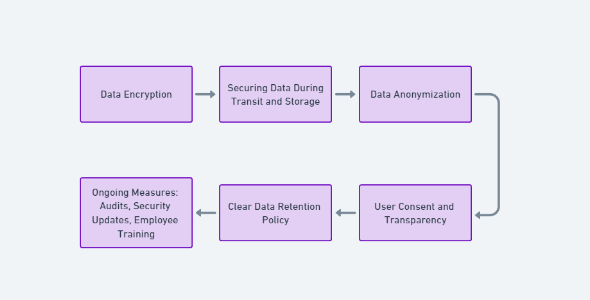
User consent and transparency are essential elements of data privatisation. AI developers must obtain informed consent users with regard to the collection and use of data, while communicating transparently about how the data will be used and stored.
Ongoing measures include regular audits, security updates and employee training programmes to adapt to changing threats, monitor the effectiveness of data protection measures and maintain a culture of data confidentiality within the organisation.
These collective efforts are essential to achieve robust data privatisation in AI tools and to ensure responsible data handling in an increasingly data-driven world.
Best practice in data privatisation
Integrating a «privacy by design» approach into the development of AI tools means a proactive commitment to privacy protection. This approach requires privacy protection considerations to be integrated transparently from the outset, at every phase of the AI tool's lifecycle.
This includes not only initial design and development, but also ongoing monitoring, updates and assessments of potential privacy risks.
By integrating privacy protection at the heart of the AI design process, companies can minimise the likelihood of privacy breaches. And ensure that data confidentiality remains a fundamental principle throughout the evolution of the tool.

What's more, transparency with users is crucial to building trust. Companies need to communicate clearly about how user data is collected, processed and stored.
This transparency fosters a sense of control and understanding among users, enabling them to make informed decisions about sharing their data.
Open and honest communication about data practices builds user confidence and can ultimately increase user engagement and satisfaction.
In addition, it is essential to keep abreast of changes in privacy laws and regulations in this ever-changing landscape in order to adapt and ensure ongoing compliance, demonstrating a commitment to privacy standards and user rights.
Implementing data anonymisation in AI tools
The’anonymisationdata
Data anonymisation is a multi-stage process designed to guarantee data confidentiality while addressing privacy concerns. Initially, data is collected with the user's consent, in compliance with ethical and legal guidelines.
Once the data has been collected, identifiable information, such as names and addresses, is either deleted or transformed using various anonymisation techniques such as data masking, pseudonymisation and generalisation.
These methods aim to make it difficult to identify specific individuals from anonymous data, while preserving the usefulness of the data for analysis and research purposes.
Throughout the process, privacy concerns are paramount. It is essential to strike a balance between utility and privacy. Excessive anonymisation of data can render it unusable for analysis, while insufficient anonymisation can expose individuals to breaches of privacy and risks of re-identification.
Rigorous testing of anonymised data is essential to ensure that even advanced data matching techniques cannot re-identify the original data, thereby maintaining a high level of privacy protection.
In today's data-centric landscape, responsible data anonymisation is essential to preserve individual privacy while extracting valuable information from the data collected.
The best tools and techniques for anonymising data
- Data anonymisation, such that CloverDX, is a fundamental practice in data confidentiality, involving common techniques such as data masking, pseudonymisation and generalisation.
- Data masking, such as the Delphix masking, consists of replacing identifiable data with fictitious but realistic information, in order to preserve the usefulness of all the data while concealing individual identities.
- Pseudonymisation, like that of’Orion, replaces identifiable data with artificial identifiers or tokens, enabling data to be linked and analysed without exposing personal details, making it attractive in healthcare and other contexts.
- Generalisation, on the other hand, transforms specific data attributes into broader categories, which reduces the granularity of the data and minimises the risk of identifying individuals.
These anonymisation methods strike a balance between the usefulness of data and the protection of privacy, which is essential for the development and deployment of AI. By implementing these techniques, organisations can harness the power of data-driven insights while protecting sensitive information and adhering to strict privacy regulations.
In doing so, it ensures that data is shared and used responsibly in the ever-changing landscape of AI technology.
Challenges and solutions in implementing data confidentiality and anonymisation
Challenges
Data confidentiality and anonymisation present a number of challenges, particularly as organisations strive to exploit big data while complying with increasing regulatory requirements and maintaining the trust of the public. public.
Balancing the usefulness of data and the protection of privacy :
- Guarantee that anonymous data remains useful for analysis while effectively masking individual identities.
Compliance with constantly changing regulations:
- Keeping abreast of privacy laws and regulations, such as the GDPR and the CCPA, and comply with them.
Risks associated with data re-identification :
- Prevent the risk that anonymous data can be traced back to individuals using advanced techniques or by combining data sets.
Complexity of data anonymisation techniques :
- Implementing sophisticated anonymisation techniques that require in-depth technical expertise, such as differential confidentiality and homomorphic encryption.
Allocation of costs and resources :
- Allocate sufficient resources and budget to implement and maintain effective privacy protection and data anonymisation programmes.
Public perception and confidence :
- Build and maintain public trust by demonstrating its commitment to privacy protection and the ethical use of data.
Solutions
Faced with increasing regulation and growing consumer awareness, businesses need to adopt robust solutions for data privatisation and anonymisation. These measures not only protect sensitive information, but also promote trust and compliance.
Implementing differential confidentiality :
- Add random noise to the data or use statistical techniques to ensure that individual data points cannot be traced back to the individuals concerned, while still allowing meaningful analysis of aggregated data.
Using federated learning :
- Process data locally on users' devices and only share model updates or information with the central server or cloud, not the raw data itself. This minimises the risk of data exposure and improves confidentiality.
Applying homomorphic encryption :
- Encrypt data so that so that they can be processed or analysed without being decrypted. This allows the data to be used in calculations in complete security without exposing the underlying information.
Data masking and tokenisation :
- Replace sensitive data elements with non-sensitive equivalents, known as tokens, which can be reduced to the original data using a secure tokenisation system, or mask the data to hide personal identifiers.
Data minimisation :
- Only collect data that is strictly necessary for the intended purpose and avoid storing excessive information that could increase the risk of a breach of privacy. This also includes deleting data that is no longer necessary.
Regular privacy audits and impact assessments:
- Conduct regular assessments to identify and mitigate privacy risks associated with data processing activities. This includes reviewing data collection, storage and processing practices to ensure compliance with privacy protection laws and regulations.
The future of data confidentiality and anonymisation in AI tools
As AI technology progresses, it brings with it evolving approaches to data confidentiality and anonymisation, with particular attention paid to the privacy of individuals.
The emergence of quantum computing promises unbreakable encryption, which could strengthen data protection and safeguard individual privacy to an unprecedented degree.
In addition, regulatory developments such as the General Data Protection Regulation (RGPD) and its global equivalents, continues to shape the data landscape in machine learning and AI through data protection laws.
These regulations underline the rights of individuals to control their personal data and require robust protection measures.

AI developers and data specialists must therefore remain vigilant and ensure that their AI systems not only comply with existing regulations, but also prioritise the protection of individual privacy throughout the data lifecycle.
In this dynamic environment, the challenge is to strike a delicate balance between the potential benefits of AI and the preservation of privacy rights.
Adaptation and innovation in the use of data and anonymisation techniques will be essential to meet the changing demands of the digital age while preserving the confidentiality and security of individual data.
Conclusion
La Implementing effective data privatisation and anonymisation practices in AI tools is a complex task that requires a thorough understanding of AI technology and privacy laws.
However, with the right strategies and techniques, companies can succeed in striking a balance between the need for useful data and the imperative of protecting users' privacy.
Not only does this help to ensure compliance with regulations on protection of privacy, but also to build trust with users, which improves the overall user experience.
Looking to develop the right AI solution to protect your data and your customers' privacy? Contact our experts at iterates.