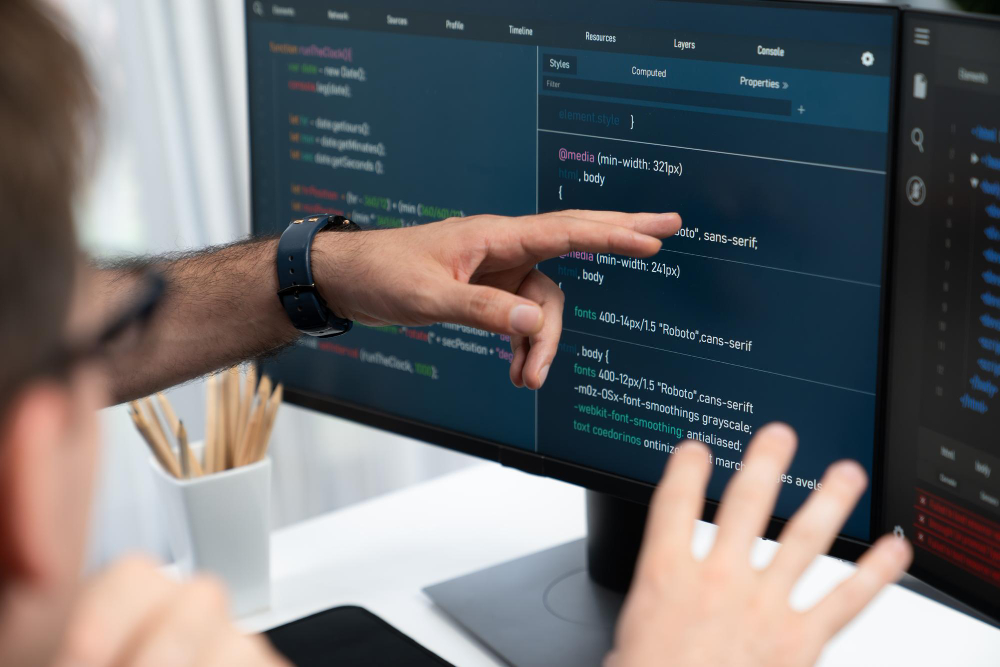
Just a few years ago, launching an app required weeks of development and a substantial budget. Today, a few well-written lines of code are all it takes to create a functional interface. Tools such as Lovable or Bolt can produce in a matter of minutes what used to take a month. This new way of creating has a name: the vibe coding.
The enthusiasm is justified. Founders, marketing managers and product managers can finally test their ideas without having to wait for a technical team. However, there almost always comes a point when the AI prototype is showing its limitations. Bugs are piling up, performance is dropping, and every change breaks something else. In this article, we’ll look at why this scenario is so common. Above all, we’ll explain how to successfully project recovery to turn your prototype into a fully-fledged product.
Vibe coding: a revolution in bringing ideas to life
The term was popularised in early 2025 by Andrej Karpathy, former Head of AI at Tesla. It refers to a way of programming where you describe what you want, and then let the AI write the code. You can find out where the term comes from at Wikipedia. The developer no longer necessarily reads every line of code they produce. They assess the result on screen and adjust their instructions as they go along.
When it comes to validating an idea, this approach is incredibly effective. An entrepreneur can present a clickable prototype to their first customers in a single afternoon. A marketing team can create an internal tool without involving the IT department. Investors can finally see the product for themselves, rather than having to rely on a PowerPoint presentation.
Le vibe coding It has therefore made software development much more accessible. It has reduced the cost of experimentation to almost nothing. However, a prototype that works in a demonstration is not yet an application ready for real users.
Why an AI prototype isn’t enough to go into production
Code generation tools are designed with a specific aim in mind: to produce a visible result quickly. Robustness, security and maintainability are often given secondary consideration. As long as the application remains a test, this trade-off is acceptable. It becomes risky as soon as real customers, real data or real payments come into play.
Invisible security vulnerabilities
La application security is the first area to watch out for. A generated code may expose API keys, fail to check permissions or leave a database accessible. These vulnerabilities are not visible on screen. The application appears to be working perfectly until the day an incident occurs.
The most common risks are well documented in the OWASP Top 10, the global benchmark in web security. Injection attacks, faulty access control and misconfigurations regularly feature in the prototypes generated by AI. A technical and security audit enables you to spot them before they become a problem.
A technical debt that is building up quickly
Every new request made to the AI adds code, rarely in a way that is consistent with what already exists. Duplicate functions appear, files grow without any logical structure, and the architecture becomes unclear. This phenomenon is known as technical debt. The more it grows, the more each update costs.
Many founders describe the same experience. They ask for a minor fix, and the tool ends up changing three other features in the process. The project then enters a frustrating cycle where more time is spent fixing things than building them.
Performance that is not keeping pace with growth
An application tested by ten people does not behave in the same way as a platform used by ten thousand customers. Poorly optimised queries, the lack of a cache or a poorly structured database will eventually slow the whole system down. The scalability This needs to be planned from the design stage, not when the servers become overloaded. AI-generated prototypes rarely take this into account.
Inadequately protected personal data
In Belgium, as elsewhere in Europe, the GDPR imposes strict obligations on the processing of personal data. A prototype may sometimes store sensitive information without encryption or a clear retention policy. The’Data Protection Authority regularly highlights companies’ responsibilities in this area. Failure to comply can prove costly, both financially and in terms of reputation.
Signs that it is time to step down
There are some tell-tale signs. You’re spending more time fixing bugs than adding features. The instructions given to the AI are producing increasingly unpredictable results. No one on the team really understands how the code is organised.
Other indicators are more strategic. You’re preparing for a funding round and investors are asking for a code audit. A major client is demanding assurances regarding the security of their data. Your user numbers are growing and the app is starting to slow down.
In each of these cases, the AI prototype has fulfilled its purpose. It has demonstrated that the market is interested in the idea. The next stage now requires a more structured approach, led by experienced developers.
How does the handover of an AI-generated project work?
Taking over an existing project requires a rigorous approach. At iterates, our service of software recovery involves several key steps, tailored to each situation.
It all begins with a comprehensive code audit. Our developers analyse the architecture, code quality, dependencies and any potential vulnerabilities. This phase provides an honest assessment of the current state of affairs, without passing judgement on the initial design choices. It results in a clear, costed recommendation.
The next step is to secure the existing system. Critical vulnerabilities are addressed as a priority, as they pose the most immediate risk. Exposed secrets are moved to a secure location, access is restricted and sensitive data is protected.
The next step involves structuring the project. The code is reorganised, documented and covered by automated tests. These tests ensure that any future changes will not break an existing feature. They restore the team’s confidence to continue developing the product.
Finally, the project has been put into production. A continuous deployment pipeline has been set up, with separate test and production environments. Updates are now reliable, fast and reversible should any problems arise.
Refactor or start from scratch?
This is often the first question our clients ask. The answer depends entirely on the state of the code and the project’s objectives.
When the codebase is sound, gradual refactoring is usually sufficient. We keep what works and improve the rest in stages. This approach keeps costs down and allows us to continue serving users whilst the work is in progress.
In other cases, the prototype was mainly used to validate the concept and user flows. Rebuilding a customised web application becomes more cost-effective in the medium term. That does not mean the work carried out is wasted. The screens, customer feedback and business logic constitute a valuable set of specifications.
This decision should never be made without careful consideration. An objective audit enables a comparison of the two scenarios in terms of cost, timeframe and risks. For projects just getting started, our approach MVP and POC It also helps to lay solid foundations right from the start.
Getting the best of both worlds
Taking over a project does not mean turning our backs on artificial intelligence. Our developers also use code assistants on a daily basis. The difference lies in the oversight. Every line of code generated is reviewed, tested and integrated into an architecture designed to stand the test of time.
This combination offers a twofold advantage. You retain the speed provided by AI to make rapid progress. At the same time, you benefit from the rigour of a team with expertise in security, performance and maintainability. Your product can therefore evolve smoothly, in step with your growth.
For companies looking to strengthen their in-house teams, our IT consultants They can also work directly alongside you. They support your staff and share best practice for the rest of the project.
Your prototype deserves to become a real product
Le vibe coding has changed the way ideas come to life. It allows a concept to be tested in a matter of days, which is a considerable advantage. However, moving from proof of concept to production requires expertise that AI tools cannot yet replace. Security, technical debt, scalability and compliance must be addressed in a systematic manner.
At iterates, our developers regularly take on projects that were initially developed using Lovable, Bolt or other similar tools. From our office in Brussels, we help start-ups and SMEs turn their prototypes into robust applications. Do you have an AI-generated project that’s reaching its limits? Contact our experts for a free initial consultation and an analysis of your code.