
Le SEO in the age of AI requires a complete overhaul of our certainties. For twenty years, the race for Google positions has structured all digital strategies. But this logic is crumbling before our very eyes. ChatGPT, Perplexity, Google Gemini and others generator motors no longer link to websites: they respond directly. Visit blue link, This historic pillar of SEO is losing its power. A new discipline is emerging Generative Engine Optimization (GEO). It's no longer a question of attracting clicks, but of becoming the source that the’IA quotes systematically. This change is not cosmetic: it fundamentally redefines the way in which brands build their brand. digital visibility. Here's how to adapt.
1. The big switch: when clicking becomes optional
The no-click referencing is radically transforming the online attention economy. Companies need to understand that website traffic is no longer the only indicator of success.
93 % of IA searches end without traffic
The figure slams home like a verdict: 93 % interactions with ChatGPT, Perplexity or Google Gemini do not generate any clicks to an external site. The user asks a question, gets a short answer, and goes on with their day. This search generative experience completely bypasses the traditional user journey. Brands that have invested heavily in Classic SEO to generate traffic are discovering that their #1 positions are producing fewer and fewer visits. Visit SEO in the age of AI requires a paradigm shift: moving from the logic of destination to that of source cited.
From search engine to response engine
Google displayed ten blue links. ChatGPT generates a response paragraph. This technological shift changes everything. The generator motors operate on the principle of RAG (Retrieval-Augmented Generation) They retrieve information from the web, synthesise it and then present it as a single answer. Users no longer need to compare several sources, the’IA has already done for it. This transformation raises a new strategic question: how does your content feed the responses generated by AI?
Why your #1 position no longer guarantees anything
Being first on Google is no longer a guarantee of being cited by ChatGPT or Perplexity. The LLM use their own source selection criteria. A site in position #5 but with verifiable data, a semantic architecture clear and a schema markup optimised site can outperform a historic but technically obsolete #1 site. This reshuffling of the cards opens up major opportunities for agile businesses that are quick to adopt the principles of GEO. Le Traditional SEO is still useful, but it's no longer enough.
2. Writing for AI: the strategic 40-60 word rule
L’AI content optimisation is based on a precise understanding of how LLM process information. Structure is becoming as important as content.
How LLMs scan and extract information
The LLM divide each web page into chunks (semantic blocks) of variable size. This process of chunking generally follows the HTML hierarchy titles H2 and H3 serve as segmentation markers. Each block becomes an independent unit potentially recoverable by the RAG. Poorly structured content generates incoherent or incomplete chunks, and therefore a low probability of being cited. Understanding this technical mechanism will enable you to radically optimise your ChatGPT visibility and Perplexity.
The «Citation Block»: the format favoured by AIs
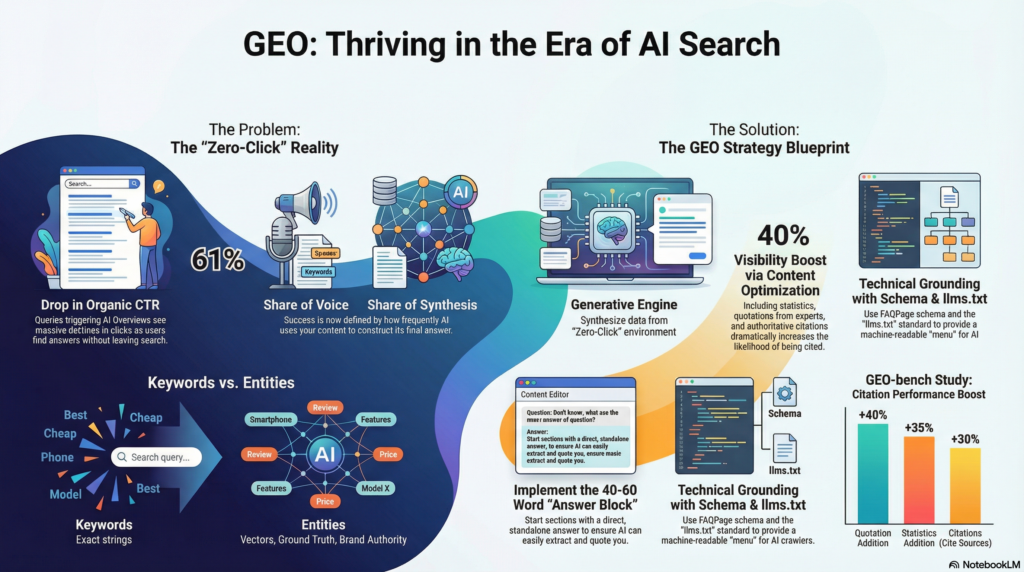
Studies on GEO reveal a consistent pattern: the blocks of 40 to 60 words are the most frequently cited by generator motors. Why is this the case? This length is the optimum format for autonomous agents long enough to be informative, yet short enough to fit seamlessly into a generated response. In concrete terms, each paragraph under your H3 should aim for this range. This Block quote becomes the atomic unit of’AI content optimisation.
Clear structure = increased visibility
A editorial architecture increases the share of IA quotes 40 %. Content structured according to a inverted pyramid (essential information first) with a HTML hierarchy clear (H1 → H2 → H3) make it easier for the LLM. Add to that short sentences, and visually distinct paragraphs, and a semantic markup (strong, em): you create an optimal environment for the algorithmic recovery. Human readability and AI crawlability converge.
3. The data are the new backlinks
In the SEO in the age of AI, l’authority is no longer built through the accumulation of external links, but through the production of original data and verifiable.
Why numbers beat marketing adjectives
The LLM are trained to distinguish between facts from opinions. Content packed with marketing adjectives («the best», «revolutionary», «exceptional») carries no weight algorithmically. Conversely, a sentence containing a precise statistics, dated, sourced is becoming a benchmark of choice. For example: «Our customers increase their conversion by an average of 40 % (internal study, n=127, Q4 2025)» systematically beats «Our solutions boost your performance». This demand for factual rigour is profoundly transforming content production.
Information Gain: what AIs are really looking for
The concept of’Information Gain measures the informational novelty of content. The generator motors texts massively value texts that provide original insights exclusive data, unpublished analyses and quantified feedback. An article republishing information that is already widely available has no value for the RAG. Strategic consequence: invest in the production of proprietary knowledge. Your case studies, sector benchmarks and analyses of customer data become your most valuable assets for your business. GEO.
Turn your business insights into a competitive advantage
Each company has a business expertise unique. The challenge: to turn it into recoverable content by LLM. Instead of keeping your internal data confidential, publish some of it. aggregated versions and anonymised. Document your methodologies. Quantify your results. Share your sector observations. This approach creates a virtuous circle the more’verifiable insights, plus IA quote you, the more your algorithmic authority increases, the more you attract customers and partners.
4. ChatGPT, Perplexity, Google AI: three rationales, three strategies
Le SEO in the age of AI can no longer be thought of in monolithic terms. Each generative engine favours different sources according to its own criteria.
Ranking Signal vs Retrieval Signal (RAG)
Le Traditional SEO Google is based on Ranking Signals backlinks, domain seniority, user engagement. The GEO operates according to Retrieval Signals : freshness of content, information density, semantic markup, data verifiability. These two approaches overlap in part but diverge fundamentally. A site can excel in Ranking (position #1 Google) but fail in Retrieval (never cited by ChatGPT). Understanding this distinction will enable you to allocate your editorial resources intelligently.
Why freshness has become critical
The LLM include a freshness bias in their algorithms of recovery. Revealing analysis: the content cited by ChatGPT are on average 25 newer % than the first Google results for the same queries. Why is this? Because the autonomous agents are looking for the most accurate updated to minimise the risk of obsolete responses. As a direct consequence continuous updating strategy is becoming more profitable than the frantic production of new content. Update your historical content every 3 to 6 months.
Adapting your GEO to suit the platform
ChatGPT favours sources encyclopaedic and academic. Perplexity enhances content community and techniques (Reddit, specialist forums, GitHub). Google Gemini favours sites that are already well positioned in Classic SEO but with a structured markup strong. This divergence calls for segmented approach Produce exhaustive background content for ChatGPT, detailed technical guides for Perplexity, and visual, well-marked content for Google AI. Le overlap between the sources cited by these platforms only reaches 11 %, confirming the need for multi-platform strategy.

5. How Iterates helps companies move from SEO to GEO
Faced with this transformation of the SEO in the age of AI, Belgian companies need support to make this strategic and technical transition.
Strategic audit: measuring your synthesis
Iterates offers a full GEO audit which measures your share of IA quotes current situation. We systematically question ChatGPT, Perplexity and Google Gemini on strategic queries in your sector to identify: are you cited? How often? In what position? How long is the extract? This AI visibility mapping reveals your gaps and opportunities. We also analyse your competitors to understand why some are capturing the market. part of synthesis you should get.
Technical architecture: Schema, llms.txt, performance
Our technical team implements the fundamentals of agentic web. We are deploying a schema markup SEO which semantically structures your content to make it easier to find recovery by LLM. We create your file llms.txt, the modern equivalent of robots.txt for RAG agents which tells IA how to browse and prioritise your content. We optimise the’Interaction to Next Paint (INP) to ensure crawlability to the maximum. These technical optimisations create the indispensable basis for any GEO strategy performance.
Information-oriented content strategy Gain and sector authority
We work with you to develop a editorial line focused on’Information Gain. In concrete terms: identifying your proprietary data processes in place to ensure that the production of original statistics, training your teams in writing in Quote Blocks of 40-60 words, systematically structured into inverted pyramid, and timetable for continuous updating. Objective: gradually build your algorithmic authority in the semantic memory from LLM, and maximise your part of synthesis on queries that are critical to your business. Visit SEO in the age of AI is not an evolution, it's a revolution. And Iterates will help you navigate it successfully.