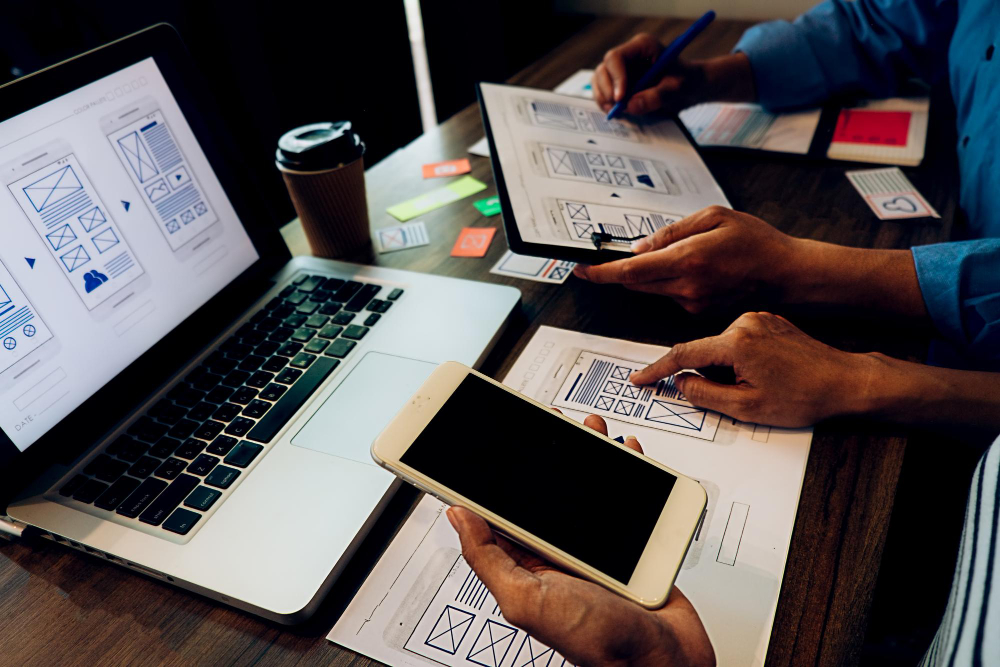
As SMEs grow, they accumulate a collection of tools that don't talk to each other. A CRM here, a spreadsheet there, emails to circulate information between the two. The result: fragmented processes, repeated errors, decisions based on incomplete data - and employees who spend an increasing proportion of their time compensating for the shortcomings of their IT rather than creating value.
L’customised business application addresses the root of this problem. According to Gartner, 70 % companies
will favour personalised applications, by abandoning generic solutions in favour of tools that are truly adapted to their processes. This fundamental trend is not a technological fad: it's the recognition that the operational performance You can't buy sustainable products off the shelf.
The standard software trap: when the tool imposes its rules on the company
Our experts in digital services see it every day in the Belgian companies they support: standard software is the number one cause of invisible productivity loss.
SaaS and software packages: the trade-offs add up
Standard software is designed to work in as many companies as possible. This is its commercial strength - and its structural limitation. To be universal, it must be generic. To be generic, it
imposes its own categories, workflows and operating logic.
Adopt a Standard SaaS, means agreeing to bend your processes to the logic of a publisher who doesn't know what it's doing.
your job. At first, the compromises seem minor. Over time, they add up: manual steps added to get around the limitations of the tool, weekly Excel exports to reconcile data, etc.
data that the application does not know how to connect, additional modules purchased to make up for missing functionality.
Pricing and technical dependency: the real cost of software rental
Le SaaS is seductive because of its apparent initial accessibility: low initial investment, rapid deployment, no server to manage. But the economic reality gradually sets in. Licence fees pile up month after month, annual price increases are structural, and every new feature you need becomes a separately billed add-on module.
The mechanics of supplier lock compounds the problem: the more you have customised your use, integrated the tool into your processes and trained your teams, the more costly and complex it becomes to consider migrating. Over five years, the initial savings from SaaS disappear completely, and the customised business application generates up to 40 % savings compared with a SaaS offering equivalent functionality.
Data silos and fragmentation: the invisible brake on your growth
The most visible symptom of the accumulation of non-integrated tools: the data silos. Your CRM doesn't talk to your invoicing tool. Your stock management is in a spreadsheet that only one person knows how to run. Management reports are assembled manually every week from five different sources.
This lack of centralisation is not just a daily inconvenience: it's a strategic brake. It slows down decision-making, generates costly errors and makes it impossible to have a real-time view of your business.

What is a business application - and how is it fundamentally different?
A definition centred on your operational reality
A business application is a tailor-made software solution designed to meet the specific needs of our customers.
specific requirements of an organisation or business sector. Whereas standard software requires you to adapt to it, a business application is built around your actual processes, your vocabulary and your constraints in the field.
Its aim is as simple as it is ambitious: to centralise your data, automate the repetitive tasks that needlessly mobilise your teams, and streamline interactions between your departments - to convert your operational performance directly into measurable profitability.
The three pillars of an effective business application
Three characteristics distinguish a genuine business application from a simple customised tool:
- Surgical customisation It's 100 % in line with your workflows, your corporate culture and your actual performance indicators.
- Deep integration It interfaces with your existing ecosystem (ERP, CRM, third-party tools) via a single interface.
open, interoperable architecture, without creating new silos.
- The sovereignty of data You own your code, your data and your development roadmap.
SaaS vs bespoke: rent your offices or build your headquarters
Opting for SaaS means renting office space: quick start-up, apparent flexibility, but permanent rent,
the walls cannot be altered, and you are totally dependent on the owner. Investing in a customised business application, Building your own head office means a higher initial investment, but a lasting asset with total freedom to develop, and an asset that adds value to your balance sheet.
This distinction CAPEX/OPEX has concrete implications. A business application transforms a recurring operating expense into an amortised capital investment - a proprietary digital asset which
is on your balance sheet and adds value to your company, particularly with a view to raising funds or selling it.
The tangible benefits of a business application for your SME
Automation and error reduction: freeing your teams from worthless tasks
How many hours do your teams spend each week re-entering data from one tool to another, manually generating reports, sending reminder emails that the application could trigger automatically? L’business process automation (BPA) eliminates this friction.
According to McKinsey, automation reduces human error by 40 % and save up to 30 % of working time on administrative tasks. This is not a marginal gain: it's a reorganisation.
of the way your company uses its human capital. Our Python automation experts job deploy these BPA architectures for dozens of Belgian SMEs.
Data centralisation: the end of decisions based on intuition
A well-designed business application connects your departments - sales, logistics, finance, production - in a continuous, coherent flow of information. Information is no longer lost in emails, duplicated in parallel spreadsheets or contradicted by the department producing it. It circulates and is updated in real time.
and feeds dashboards that give your management a precise and instantaneous view of your business.
Mobility and collaboration: work effectively anywhere, including offline
A modern business application is designed from the outset to be used everywhere: a responsive interface adapted to mobile devices, cloud synchronisation for dispersed teams, and offline mode for
environments with low connectivity - building sites, warehouses, rural areas, travel. Our consultants React specialising in mobile interfaces build these multi-media experiences adapted to the realities on the ground.
An asset that adds value to your balance sheet
The business application is not just an operational tool: it's a strategic asset. As a
as the owner of the source code and all the developments carried out, you have access to a wealth of information.
digital asset on your balance sheet, which can be used to raise funds, enter into a strategic partnership or sell a company.
Business applications by sector: how tailor-made solutions can be applied to your sector
Le public works and construction sector concentrates exceptionally complex logistical challenges: coordinating multiple subcontractors, monitoring progress on dozens of simultaneous sites, managing deliveries, document compliance, and tracing incidents.
A dedicated business application can connect the entire chain: from planning to delivery.
supplies to site acceptance. Platforms such as Batail-log illustrate this potential, connecting several thousand partner warehouses to optimise deliveries and reduce the carbon impact of operations.
Human resources: automating recruitment and talent management
The recruitment process involves a considerable volume of manual tasks with little added value: sorting applications, formatting CVs, coordinating interviews, following up, onboarding. An HR business application can automate this entire workflow - right down to automatically generating CVs in the following formats
from the profiles received.
Logistics and industry: anticipating breakdowns, eliminating disruptions
In the industrial and logistics environments, downtime is directly reflected in lost production. A business application integrating real-time fault management, scheduled preventive maintenance and stock monitoring with automatic alerts transforms the company's approach from reaction to prevention.
Health: traceability, RGPD compliance and continuity of care
Le health sector combines requirements that make generic solutions particularly unsuitable: confidentiality of patient data, strict traceability of procedures, interoperability with hospital systems, and compliance with demanding regulatory standards. A business application developed for a
health integrates these constraints from the design stage.
From need to deployment: the methodology that guarantees success
Immersion and mapping of real processes
A successful business application project begins long before the first line of code is written. The immersion phase
is to understand your operational reality in depth: to observe processes as they really work on the ground, to identify friction, workarounds and information that gets lost. Visit
sessions’Event Storming - collaborative workshops bringing together business users and developers - are particularly effective for mapping complex workflows.
Co-design and prototyping: validate before coding
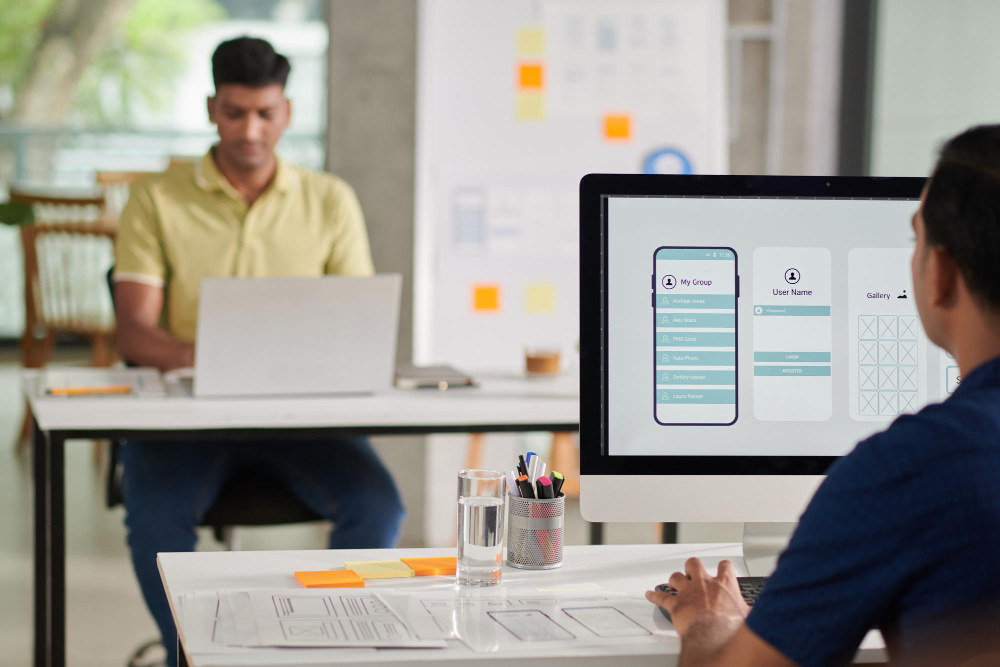
Before writing a single line of code, the co-design enables the interfaces and user paths to be materialised in the form of interactive mock-ups (Figma wireframes). This stage is critical: it enables us to validate with future users that the application does indeed meet their real needs, to identify the
misunderstandings early on - when corrections are inexpensive.
Agile development and MVP: delivering value from the outset
Development in agile mode proceeds by short sprints of two to four weeks, each delivering a functional increment that can be tested in real-life conditions. The MVP (Minimum Viable Product) is the version
of the application, validating key assumptions and generating value for users.
Testing, deployment and change management
Technical robustness is achieved through rigorous automated testing: functional tests, load tests, security and compliance audits. Deployment is not the end of the project: it's the start of the adoption phase. The success of a business application depends on 80 % quality of change management support.
Budget and ROI: understanding the investment to size it correctly
Budget ranges according to scope
| Type of solution | Perimeter | Budget range |
| MVP / Specific tool | Business forms, targeted reporting | 3 000 € - 15 000 € |
| Intermediate application | SME CRM/Intranet, secure workflows, 10-50 users | 15 000 € - 75 000 € |
| ERP / Complex platform | Multi-process, MACH architecture, AI, 100+ users | 75 000 € - 300 000 €+ |
Hidden costs and maintenance: anticipate to avoid suffering
A sound project includes the ongoing costs of the application from the outset. Plan on an annual budget of
maintenance representing between 15 % and 25 % of the initial development cost. This amount covers corrective maintenance (bugs), adaptive maintenance, management of the technical debt, and user support.
Allow a safety margin of 10 to 20 % on the initial development budget to absorb the functional changes that inevitably emerge as a result of contact with reality in the field.
Return on investment: what the figures really say
For 60 % companies having invested in a customised business application, the return on investment reached 200 % over three years. In some cases, ROI is achieved by four to nine months only.
These figures can be explained by the combination of two levers: the reduction of operational costs (automation, elimination of errors, elimination of multiple SaaS licences) and the increase in the number of SaaS licences.
commercial performance (better customer responsiveness, faster decisions, ability to handle more volume without increasing staff numbers).
Iterates, your partner for developing the business application that makes the difference
At Iterates, we support Belgian and European SMEs from idea to deployment - starting with
It's not a technology stack we're trying to sell. Our approach starts with a 5-day IA audit Mapping your actual processes, identifying the most costly frictions, and targeting high-impact automation opportunities before writing a single line of code.
We master the whole technical spectrum - React, Node.js, Python, cloud-native and API-first architectures - but our real added value is understanding your sectoral challenges.
Ready to transform your operational performance?
Off-the-shelf software has served SMEs well in the start-up phase. But as your
As your business becomes more structured, as your processes become more differentiated, and as your growth depends on your ability to execute faster and better than your competitors, this advantage is reversed. The tool that was useful to you becomes a hindrance.
A business application is not a project reserved for large companies or large budgets. It's a progressive, scalable and measurable investment. The real question is not «do I have the resources?
What is the cost of doing nothing?»
→ Let's discuss your project with Iterates - 5 % IA audit jbears to map your processes and identify your immediate gains.